Introduction
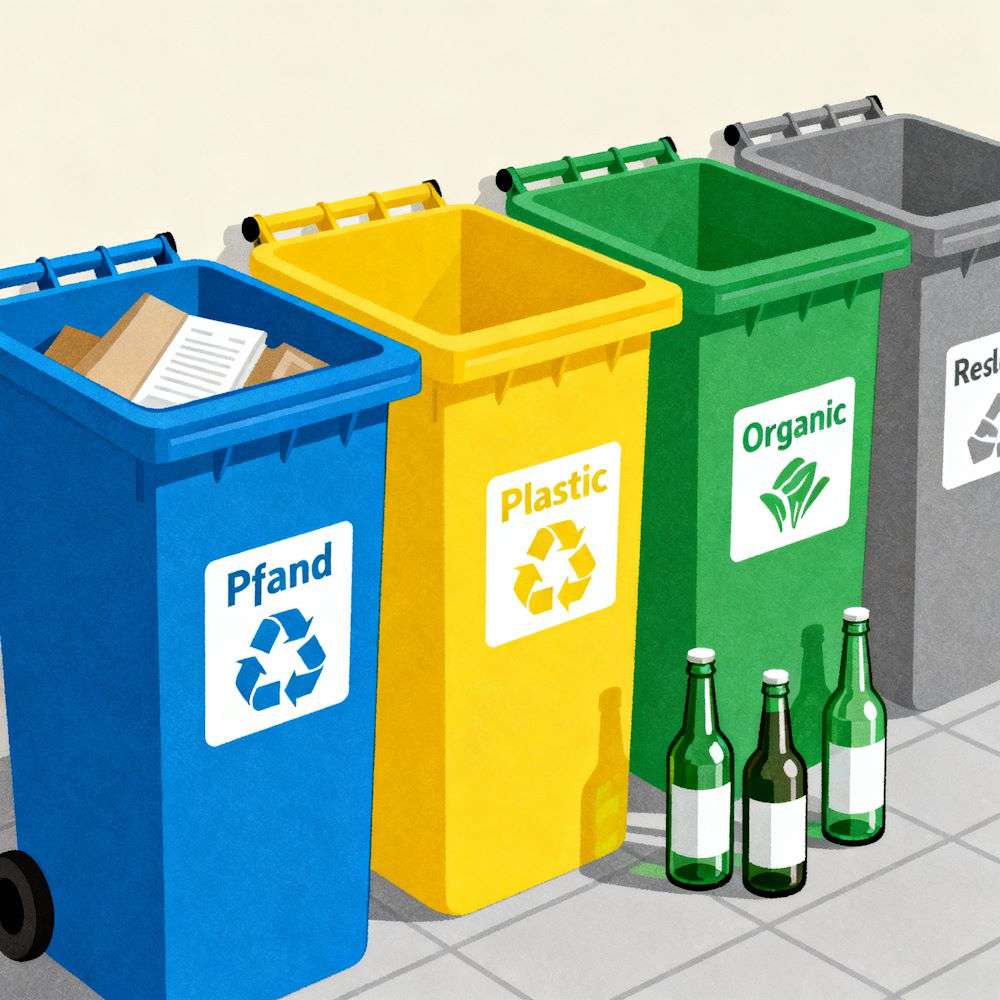
Germany operates one of the world’s most structured waste separation systems, and Lower Saxony (Niedersachsen) follows these national requirements with local execution by municipalities. Newcomers can avoid fines and reduce environmental impact by understanding which materials belong in each stream, how the deposit system (Pfand) works, and where to take special waste such as electronics and batteries [1,2,11,12].
Legal Framework: What Makes Waste Separation Mandatory
The national Circular Economy Act (Kreislaufwirtschaftsgesetz, KrWG) requires the separate collection of paper, glass, plastics/metals (packaging) and bio-waste; this nationwide obligation has applied since 1 January 2015 [1,3]. The act underpins municipal systems in Lower Saxony, which then set practical rules (collection calendars, container sizes, fees) at city and county level [1,12].
The Packaging Act (Verpackungsgesetz, VerpackG) creates extended producer responsibility and the “dual system” for packaging—the legal basis for the familiar yellow bag/bin for light packaging [4]. Single-use beverage containers are subject to a mandatory deposit scheme, with scope and technical rules defined under VerpackG and administered operationally via the DPG one-way deposit system [5,6].
Electrical and electronic equipment is governed by the Electrical and Electronic Equipment Act (ElektroG). Retailers and many supermarkets must take back small waste electrical and electronic equipment (WEEE) up to 25 cm edge length free of charge, even without a new purchase, and they must accept larger items on a one-for-one basis when you buy a replacement [8,14]. Batteries are covered by the Batteries Act (BattG); consumers are legally obliged to return used batteries to authorized collection points (shops or municipal facilities) and must never place them in household bins [10].
The Standard Streams and What Goes Where
Paper/Cardboard (Blue Bin)
Place clean paper, cardboard and cartons—flattened to save space—in the blue bin. Exclude wet, heavily soiled or coated paper (e.g., wallpaper), which can reduce recycling quality and may belong in residual waste depending on local guidance [11].
Light Packaging (Yellow Bag/Bin)
The yellow stream is only for packaging made of plastic, metal or composite materials: yogurt cups, plastic bottles without deposit, tins, aluminum trays, and beverage cartons (e.g., Tetra Pak) [4,11]. Do not place non-packaging plastics (toys, buckets, utensils) in the yellow bag unless your municipality explicitly operates a “Wertstofftonne” that accepts similar non-packaging materials; in many Lower Saxony municipalities, these items belong in residual waste or must be taken to a recycling depot [11]. Empty items and place them loosely (do not nest materials) to aid automated sorting [11].
Bio-Waste (Brown/Bio Bin)
Bio-waste typically includes uncooked fruit and vegetable scraps, coffee grounds/filters, tea bags and small amounts of garden clippings. Many municipalities exclude cooked leftovers, meat or fish remains from the bio bin, and “biodegradable” plastic bags are usually not allowed. Always check your local instructions in Lower Saxony [11,12].
Residual Waste (Restmüll)
Residual waste is for anything that does not belong in the other streams: hygiene products, vacuum cleaner bags, ceramics, heavily soiled items and some composites that cannot be separated. Cold ash and cat litter may be allowed in small quantities, but confirm locally [11,12].
Glass (Bottle Banks/Igloos)
Use public glass banks and sort by color (white/clear, brown, green). Remove metal caps and plastic lids; these are packaging and typically belong in the yellow stream. Deposit (Pfand) bottles should be returned at shops rather than placed in glass banks [5,11].
The Deposit System (Pfand): What to Return and Why It Matters
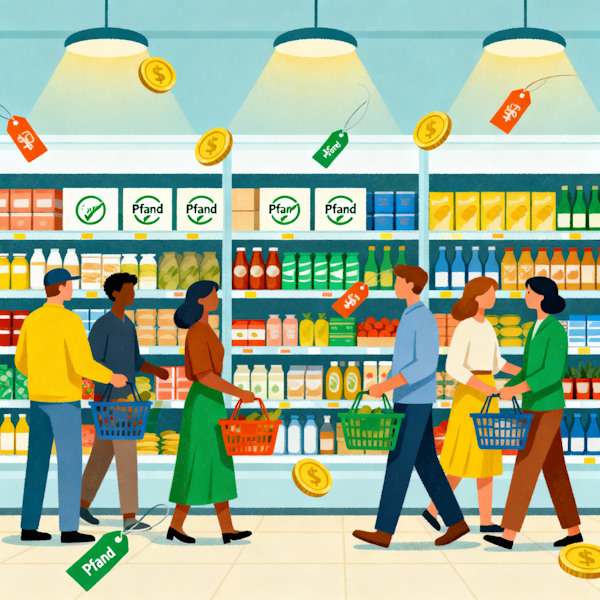
Germany’s deposit return scheme (DRS) achieves exceptionally high return rates—often cited near 98% for eligible single-use containers—by combining a meaningful deposit value with a dense network of return points [7]. Most single-use plastic bottles and cans carry a €0.25 deposit, and many reusable bottles (glass or PET) carry lower deposits (commonly €0.08–€0.15); you reclaim deposits via reverse-vending machines or staffed returns at supermarkets [5,6,7].
As of 1 January 2024, drinkable milk products in one-way plastic bottles (0.1–3.0 L)—including milk drinks, kefir and many yogurt drinks—became subject to the mandatory €0.25 deposit. Look for the DPG logo on the label to confirm deposit status [5,6]. Items exempt from deposit (e.g., some cartons/cups) should be recycled through the appropriate stream (yellow or paper, depending on the packaging) [5].
Electronics, Batteries and Hazardous Items: Keep Them Out of Household Bins
Electronics (WEEE)
Small devices (≤25 cm external dimension)—such as razors, remote controls, smartphones or headphones—can be returned to qualifying retailers and many supermarkets free of charge without buying anything new. Larger devices are accepted on a one-for-one basis when purchasing a replacement. Municipal recycling depots (Wertstoffhöfe) also accept WEEE. Never put electronics in residual, yellow, blue or bio bins [8,9,14].
Batteries and Accumulators
Batteries, including Li-ion cells (e.g., e-bike packs, tool batteries) and button cells, must be returned to authorized take-back points at retailers or municipal collection centers. Disposing of batteries in household bins is illegal and dangerous due to fire risk and hazardous substances [10].
Hazardous Household Waste
Paints, solvents, certain cleaners, fluorescent tubes and energy-saving lamps require special handling. Many municipalities in Lower Saxony provide mobile pollutant collection units (Schadstoffmobil) and fixed depots; check local schedules and accepted items. Do not pour chemicals down drains or place them in household bins [11,12].
Lower Saxony (Niedersachsen) Local Practice: What Changes by City/County
While federal law standardizes the streams, cities and counties in Lower Saxony publish practical “how-to” rules: which container types are used (yellow bag versus yellow bin), how to order or exchange containers, collection days, and how to book bulky-waste pickup. Always consult your municipal operator’s English pages and waste calendars [11,12].
Region Hannover (aha). The aha association provides clear English guidance that illustrates what belongs in each stream and how to dispose of special waste. The guide reflects common color coding (blue/paper, yellow/packaging, brown/bio, black/residual) and explains special take-back for batteries and electronics. If you live in Hannover or a county served by aha, their materials are an excellent practical reference [11].
City of Oldenburg. Oldenburg’s Welcome Center hosts an English “Waste disposal – how & when” page, linking to an up-to-date removal calendar and a detailed sorting guide. It also points to municipal depots and public containers for glass and textiles. New residents can use these resources immediately after registration to avoid missed collections [12,13].
Collection Calendars, Bulky Waste and Extra Services
Municipalities in Lower Saxony publish annual collection calendars that specify pickup days for each stream; many also offer reminder apps. Place containers the evening before, as trucks may arrive early. Ensure bins are visible and accessible; blocked access or overfilled bins may be left uncollected [11,12].
Bulky waste (Sperrmüll). Most cities require an appointment (online or by card/phone) for bulky items such as furniture. Oldenburg’s Citizens’ Office also sells cards for bulky-item collection and official waste bags; unauthorized placement on streets can lead to warnings or fees [12,15].
Extra pickups and swaps. Many municipalities allow one-off residual or bio pickups (often for a fee) and container size changes to match household needs. Distribution of yellow bags (if used) may occur at designated points (e.g., town halls, shops) rather than by home delivery. Confirm the procedure for your street address [11,12].
How to Avoid Common Mistakes
Only packaging in the yellow stream. The yellow bag/bin is not a general “plastic” bin. Non-packaging plastics usually do not belong unless a local “Wertstofftonne” is explicitly provided [4,11].
Keep materials empty and loose. Rinse lightly if needed, separate lids/films from trays, and avoid nesting different materials. This improves sorting accuracy and recycling yields [11].
Bio means organic, not “bioplastic.” Compostable/biodegradable plastic liners are generally not accepted in bio bins in Lower Saxony. Use no liner or plain paper if permitted locally, and avoid cooked foods or animal products unless your municipality explicitly allows them [11,12].
Pfand vs. glass bank. Deposit containers should go back through the Pfand system so you reclaim the deposit and keep them in the high-quality return loop. Use glass banks for non-deposit jars and bottles only [5,6,11].
Never in household bins. Batteries, electronics, chemicals and fluorescent lamps require take-back points or municipal facilities. Many supermarkets now also accept small WEEE due to expanded take-back obligations, which makes compliant disposal easier during regular shopping [8,10,14].
Getting Started in Your First Week
Identify your local operator’s English page, download the collection calendar (or app), and locate the nearest public glass banks and recycling depots. If you have deposit containers, return them at the supermarket to reclaim deposits. Keep a “special box” at home for batteries and small electronics so you can take them to retailers during your next shopping trip. Following these steps will keep you compliant with Niedersachsen rules from day one [7,10,11,12].
References
1. Umweltbundesamt (UBA) – Waste management: separate collection from 2015. https://www.umweltbundesamt.de/en/topics/waste-resources/waste-management
2. Umweltbundesamt (UBA) – Waste regulations overview (KrWG context). https://www.umweltbundesamt.de/en/topics/waste-resources/waste-management/waste-regulations
3. European Environment Agency (EEA) – Germany chapter confirming 2015 separate collection. https://www.eea.europa.eu/publications/many-eu-member-states/germany
4. Zentrale Stelle Verpackungsregister (ZSVR) – Packaging Act (VerpackG) overview. https://www.verpackungsregister.org/en/foundation-authority/packaging-act
5. ZSVR – Deposit obligation for single-use beverage packaging (incl. milk drinks 2024). https://www.verpackungsregister.org/en/knowledge-bases/deposit-obligation-for-single-use-beverage-packaging
6. DPG (Deutsche Pfandsystem GmbH) – Expansion of deposit obligation as of 1 January 2024. https://dpg-pfandsystem.de/en/the-one-way-deposit-system/useful-information/notices/expansion-of-deposit-obligation-as-of-1-january-2024.html
7. TOMRA – Germany’s deposit return scheme performance (context). https://www.tomra.com/reverse-vending/media-center/feature-articles/germany-deposit-return-scheme
8. Umweltbundesamt (UBA) – Electrical and Electronic Equipment Act: small WEEE take-back without purchase. https://www.umweltbundesamt.de/en/topics/waste-resources/product-stewardship-waste-management/electrical-electronic-waste/electrical-electronic-equipment-act
9. Umweltbundesamt (UBA) – Electrical and electronic waste: consumer obligations and options. https://www.umweltbundesamt.de/en/topics/waste-resources/product-stewardship-waste-management/electrical-electronic-waste
10. Federal Environment Ministry (BMUV) – Batteries Act (BattG): consumer return obligations. https://www.bundesumweltministerium.de/en/law/batteries-act
11. Region Hannover (aha) – English separation guide (what goes where). https://www.aha-region.de/fileadmin/Download/pdf/2021-06-17_Kurzuebersicht_richtig_trennen_ENGLISCH.pdf
12. City of Oldenburg – Waste disposal “how & when” (English). https://www.oldenburg.de/microsites/welcome-center/living-in-oldenburg/waste-disposal.html
13. University of Oldenburg – Good to know (links to city waste information). https://uol.de/en/international-researchers-and-staff/living-in-oldenburg/good-to-know
14. Umweltbundesamt (UBA) – Press information (29 June 2022): 25,000 additional collection sites for small WEEE via supermarkets/chemists. https://www.umweltbundesamt.de/en/press/pressinformation/from-1-july-25000-additional-collection-sites-for
15. City of Oldenburg – Citizens’ Office: bulky item cards and waste bags. https://www.oldenburg.de/sprachversionen/gb/new-citizens/citizens-office.html