Learning German is one of the most important steps for settling into life in Lower Saxony. Whether you are studying at a university, working, or joining a partner, German will help you understand letters from authorities, speak with neighbours, and feel more confident in everyday situations. In this guide, we look at the main options for learning German in Lower Saxony, with a focus on practical choices for students and newcomers.
You will read about the common language levels (A1 to C2), how public adult education centres (Volkshochschule or VHS) work, what private language schools offer, and how university courses and apps can support you. The goal is not to tell you that one way is “best” but to help you combine classroom learning with real life in Oldenburg, Hannover, Braunschweig, and other cities in Lower Saxony.
Understanding German Language Levels (A1 to C2)
In Germany, language levels normally follow the Common European Framework of Reference for Languages (CEFR). The CEFR defines six main levels from A1 (beginner) to C2 (near native) and describes what learners can do in listening, speaking, reading, and writing at each stage [1][2]. Many schools, universities, and employers use these levels when they ask for “B1” or “C1” German.
Very simply, you can think of the levels like this (only a rough idea):
- A1 - A2 (Basic user): You can handle simple everyday sentences, introduce yourself, ask and answer basic questions in shops or at the doctor. You still need people to speak slowly.
- B1 - B2 (Independent user): You can manage everyday life mostly on your own, talk about experiences and plans, understand main points of TV and radio, and read simpler texts. Many integration courses aim at B1 [3][4].
- C1 - C2 (Proficient user): You can follow complex discussions, study at a German university, and write texts in a formal style. Many German-taught degree programmes expect at least C1 [1].
When choosing a course in Lower Saxony, always check which level it teaches and if there is a placement test. A good school will not simply put you in “any” group but will check your current level first.
Learning German at Volkshochschule (VHS) in Lower Saxony
The Volkshochschule (VHS) is a public adult education centre that exists in many cities. In Lower Saxony, you can find a VHS in places like Oldenburg, Hannover, Braunschweig, Osnabrück, Göttingen, and many smaller towns. VHS courses are usually cheaper than private schools because they receive public funding. Many VHS centres offer different formats: open German courses, integration courses, job-related language courses, and special courses for refugees [4][5].
For example, VHS Oldenburg offers different formats for “Deutsch als Fremdsprache” and “Deutsch als Zweitsprache” for levels A1 to C1, including evening classes that are suitable if you study or work during the day [4]. Other VHS centres in Lower Saxony have similar structures.
Integration Courses (Integrationskurs)
Integration courses are officially funded language and orientation courses organised by the Federal Office for Migration and Refugees (BAMF). They normally include 600 hours of language instruction and 100 hours of an orientation course about German law, history, and values [3][4]. The aim is to reach B1 level so that participants can manage everyday life more independently.
Important points about integration courses in Lower Saxony:
- Who can join? Many non-EU newcomers with a longer residence perspective can receive an entitlement or obligation to attend an integration course. The exact rules depend on your residence title and are decided by the Ausländerbehörde or BAMF [3].
- Costs: For many people, the government pays a large part of the course fee. Some participants pay a reduced contribution per lesson, and there is sometimes a partial refund if you pass the final exam quickly [3].
- Content: The course focuses on everyday communication (job, doctor, school, authorities) and ends with a language test at level B1 and a separate test on knowledge about life in Germany [4].
- Where to find a course: You can search for integration courses near you using the BAMF-NAvI online tool or ask at your local VHS in Lower Saxony [3].
Standard German Courses at VHS
Besides integration courses, VHS centres also run open German classes that are not directly funded as integration courses. These classes may:
- cover different levels (for example, A1 to C1) in evening or intensive formats,
- prepare for exams such as telc, TestDaF or Goethe certificates,
- be mixed groups of students, workers, and other residents [4][5].
If you are a university student in Oldenburg or Hannover, an evening course at the VHS can be a good way to slowly improve your German while studying in English, especially if you do not have to reach a high level very fast.
Read more: Practical tips for everyday communication and politeness in Lower Saxony
Private Language Schools in Lower Saxony
Private language schools are another common option, especially in larger cities like Hannover, Braunschweig, or Göttingen. These schools are usually more expensive than VHS but often offer more flexible timetables, smaller groups, or intensive courses with many hours per week. Some of them are officially recognised exam centres for telc, TestDaF, or other certificates, which can be important if you need a specific exam for university or visa purposes [1][3].
Typical advantages of private schools in Lower Saxony are:
- very intensive courses (for example, 20 - 30 lessons per week),
- shorter waiting times to start a new course,
- special preparation courses for exams like TestDaF or DSH,
- more individual attention in small groups.
On the other hand, prices are often much higher than at the VHS, and you need to check carefully whether a course really leads to an officially recognised certificate.
What to Check Before You Enrol
Before you sign a contract with a private language school in Lower Saxony, consider the following points:
- Accreditation and exams: Does the school cooperate with recognised exam providers (for example, telc, TestDaF, Goethe)? This is important if you need proof of B2 or C1.
- Visa and residence status: If you plan to switch from a language course visa to another status later, make sure the course is intensive and officially accepted by the Ausländerbehörde. When in doubt, ask the authorities before you pay.
- Contract details: Check course duration, cancellation rules, refund policy, and what happens if a group has too few participants.
- Placement test: A serious school will test your level before placing you in a group.
It can be useful to compare the offer of a private school with your local VHS. Sometimes a combination works well: for example, an integration course at VHS plus a short, private exam preparation course.
University Language Courses and German for Students
Many universities in Lower Saxony, including the University of Oldenburg, offer German language courses through their language centres (Sprachenzentrum). These courses can be aimed at enrolled international students, exchange students (Erasmus), or sometimes external learners. They usually follow the CEFR levels and may offer courses that run alongside your main studies [2][6].
As a student, you should check:
- if your university offers free or reduced-price German courses for enrolled students,
- whether there are intensive courses before the semester starts,
- if the course gives ECTS credits or only a certificate of participation,
- whether the course prepares you for exams like DSH or TestDaF if you plan to switch to a German-taught programme.
Sprachenzentrum and International Office
At most universities, two offices are important for German courses: the language centre and the International Office. The language centre organises the courses and placement tests; the International Office can advise you on which level you need for specific study programmes and how language courses fit your study plan [6]. Their websites usually provide up-to-date information on registration deadlines, course formats, and exam dates.
If you already live in Lower Saxony and plan to apply for a German-taught degree, it can be helpful to take a university German course one or two semesters earlier. This way, you learn study-related vocabulary and academic skills (presentations, essays) that you will need later.
Self-Study and Apps: Learning German Outside the Classroom
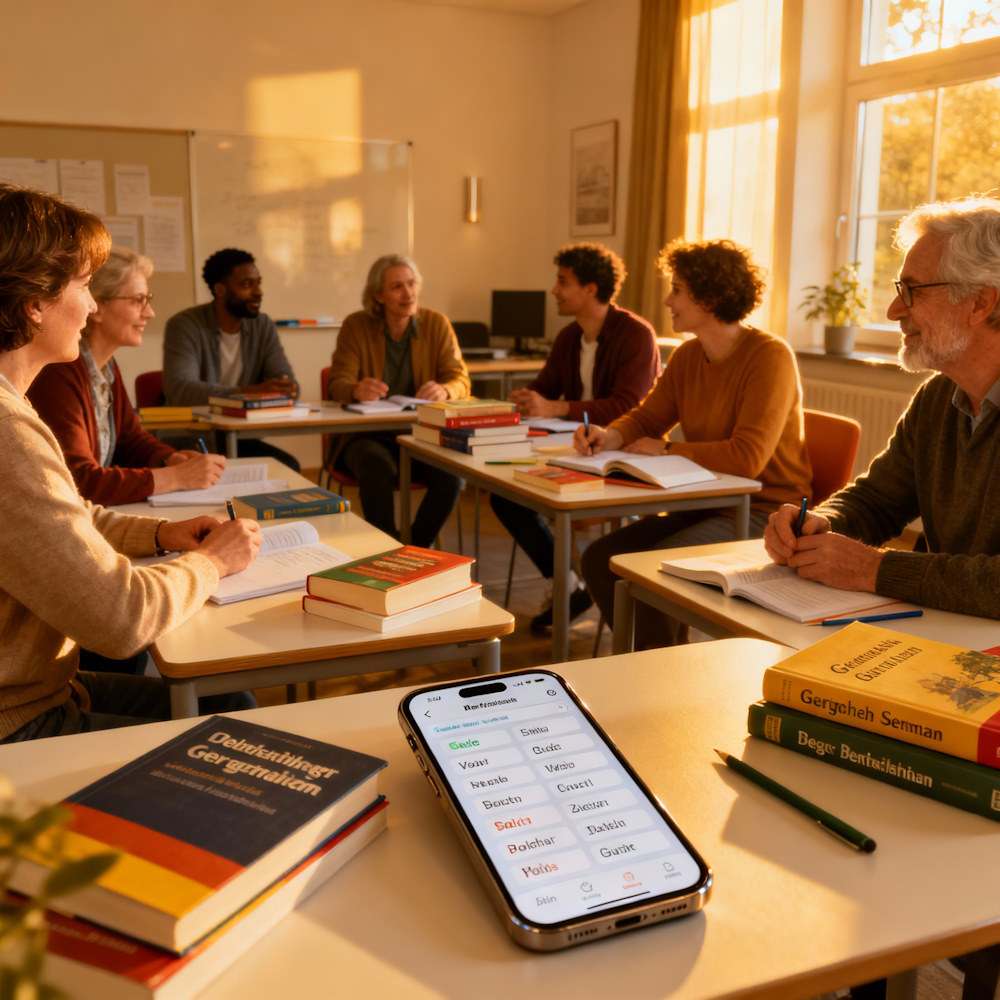
Classroom teaching is very important, but it is usually not enough on its own. Combining courses with self-study and digital tools can make your progress much faster. The good news is that there are many free or low-cost resources you can use from your room in Oldenburg, Hannover, or any other city.
Popular options include:
- Apps for vocabulary and short exercises (for example, general language-learning apps on your phone).
- Video series like the free “Nicos Weg” German course by Deutsche Welle on YouTube, which combines story-based videos with exercises for levels A1 to B1 [7]. You can find the playlist here: Nicos Weg - Learn German playlist.
- Online exercises from public broadcasters and universities, which often follow CEFR levels.
- Reading practice with simple news websites or children’s books in German.
Self-study is flexible and can fit around your lectures or work. However, it requires discipline. A good strategy is to set a fixed small goal, for example 20 minutes of app practice every evening plus one video episode three times a week.
Using Everyday Life in Lower Saxony as a Classroom
No matter which formal course you choose, your real classroom is everyday life in Lower Saxony. You will meet German in supermarkets, on buses, at university, and in clubs. Using these situations actively can greatly improve your learning.
Here are some practical ideas:
- Join local clubs and groups: Sports clubs, music groups, or volunteer projects are great for practising German in a friendly environment. You can find a local club and learn how club life works in Lower Saxony.
- Talk to neighbours and classmates: Even short conversations in the staircase or at the bus stop help you gain confidence.
- Use written materials: Try to understand letters from authorities before you switch to Google Translate. Look at advertisements, posters, and supermarket brochures as reading practice.
- Media in German: Watch German TV with subtitles, listen to local radio, or follow German podcasts for learners.
Do not worry about mistakes. Many people in Lower Saxony are happy when newcomers try to speak German, and small errors are completely normal. What matters most is regular practice.
Choosing the Right Path for Your Situation
Every newcomer’s situation is different. The “best” path depends on your visa type, money, free time, and goals. Here are some typical scenarios:
- Student in an English-taught programme: Combine a university German course or VHS evening class with self-study apps and conversation practice. Aim at B1 or B2 to feel comfortable in everyday life and maybe open options for later German-taught studies.
- Family reunion or long-term residence: If you receive an integration course entitlement or obligation from BAMF, use it and try to complete the course as quickly as possible. Combine it with extra practice at home or a conversation group to make sure you really reach B1 [3][4].
- Job seeker or worker: Look for flexible evening or weekend courses at VHS or private schools. Focus on job-related vocabulary and communication with colleagues and authorities.
- Limited budget: Use public options like VHS and free online resources. Paid apps can be helpful, but they are not necessary if you use good free material consistently.
It is completely normal to change course type over time. For example, you might start with an integration course, then switch to a university course later, and always keep apps and everyday practice as a constant support.
Staying Motivated on Your German Journey
Learning German can feel difficult, especially when you are also dealing with visas, housing, and university deadlines. To stay motivated:
- set small, realistic goals (for example, “understand my rental contract better” or “talk for five minutes in German at a party”),
- celebrate progress, even small steps,
- find a study partner from your course to practise together,
- connect language learning with topics you love (sports, music, cooking, technology).
Remember that language learning is not a race. Many people in Lower Saxony need several years to reach B2 or C1, especially if they work or study at the same time. What matters most is regular, steady practice and a combination of good courses and real-life use.
References
- [1] Goethe-Institut. “German language levels A1–C2 - Common European Framework of Reference for Languages (CEFR).” Accessed 17 November 2025.
- [2] Council of Europe. “The CEFR Levels - Common European Framework of Reference for Languages.” Accessed 17 November 2025.
- [3] Federal Office for Migration and Refugees (BAMF). “Integration courses.” Overview of course types, participation rules, and costs. Accessed 17 November 2025.
- [4] Federal Office for Migration and Refugees (BAMF). “The Integration Course.” Graphic overview (language course 600 hours + orientation course 100 hours, target level B1). Accessed 17 November 2025.
- [5] Volkshochschule Oldenburg. “Deutsch - Deutschkurse and Offene Deutschkurse (A1–C1).” Information on course formats and levels. Accessed 17 November 2025.
- [6] Example university language centre in Germany. “Language courses organised according to CEFR A1–C2.” Information on university-based German courses and levels. Accessed 17 November 2025.
- [7] Deutsche Welle (via YouTube). “DW Deutsch lernen (A1, A2, B1) | Nicos Weg – Einfach Deutsch lernen.” Video-based German course playlist. Accessed 17 November 2025.