
Starting a job in Lower Saxony can feel like joining a new sport team where everyone already knows the rules, but nobody wrote them down. You might be great at the actual work, yet still wonder things like, “Do I say hello to everyone in the hallway?” or “Why does everyone suddenly stand up at 12:00 and say the same word?”
This article is a practical, light guide to the unwritten side of working life in Lower Saxony. I will not go into legal or sensitive topics, and I will focus on the everyday, social part that helps you feel comfortable faster. Think of it as cultural “leveling up” that saves you stress, helps you connect with colleagues, and prevents awkward moments that are totally normal for newcomers.
Use it like a checklist for your first weeks, and adapt it to your workplace. A small startup in Hannover may feel different from a factory near Wolfsburg, but many day-to-day patterns are surprisingly similar across Germany. [1]
The Big Picture: How Work Often Feels in Germany
Many workplaces in Germany value a structured approach: clear planning, clear responsibilities, and meetings that stick to a point. People can sound direct, even when they are not angry. Often, the goal is efficiency, not coldness. [1]
Punctuality is also treated as a kind of respect. If a meeting starts at 10:00, it usually starts at 10:00, not “around 10.” It is normal to arrive a few minutes early, especially for something important. [2]
Another common pattern is the idea that work time and private time are separate. People may be friendly at work, but still keep their private life private at first. Over time, this can change, especially after you build trust.
- Helpful mindset: “Clear and direct” usually means “professional,” not “rude.” [1]
- Helpful habit: Write things down, confirm details, and use your calendar like a best friend. [1]
- Helpful attitude: If you are unsure, ask once, politely, and move on. That is respected more than guessing.
Du or Sie: The Name and Greeting Puzzle
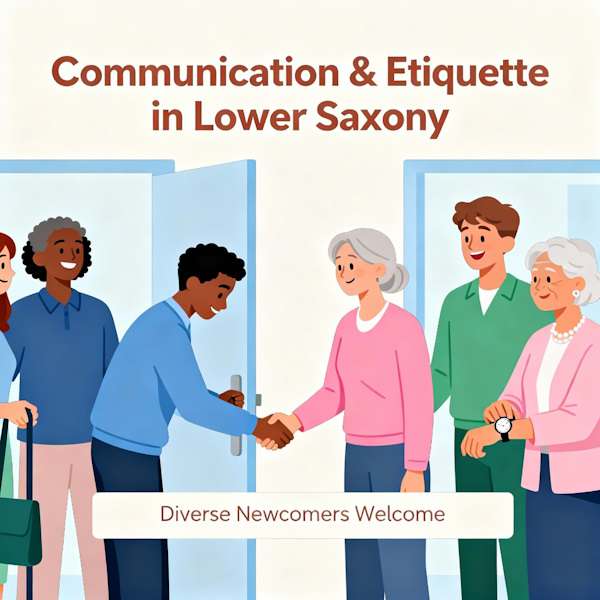
One of the first cultural questions newcomers face is how to address colleagues. German has both Sie (formal “you”) and du (informal “you”). In many workplaces, you start formal, and later people may offer “du.” In others, “du” is normal from day one, especially in younger teams or some industries. [3]
A safe default for your first days
If you are unsure, start politely and slightly formal. You can use greetings that work in most situations, and listen to what others do. A simple “Guten Morgen” or “Hallo” is usually safe. If emails are formal in your workplace, you may see “Sehr geehrte(r) …” or “Guten Tag …” in the beginning.
- Safe spoken opener: “Guten Morgen” (morning), “Guten Tag” (day), “Hallo” (neutral)
- Safe first question: “Wie sprechen wir uns hier an, du oder Sie?” (How do we address each other here, du or Sie?) [3]
How the switch to “du” usually happens
In many places, the switch happens because someone explicitly offers it, like “Wir können uns duzen.” If a colleague says that to you, it is an invitation. If nobody offers it, staying formal can be totally normal. [3]
Also, do not be surprised if two colleagues use “du” with each other, but “Sie” with a client or a manager. Context matters.
Read more: Practical etiquette tips for everyday conversations and politeness in Lower Saxony
Time Culture: Meetings, Breaks, and the Calendar Life
If you want one “easy win” in Lower Saxony work life, choose this: be reliable with time. Being late can be seen as disrespectful, even if nobody says it directly. A common recommendation is to arrive five to ten minutes early for important appointments. [2]
German workplaces also love scheduling. If someone says, “Let’s talk later,” they often mean, “Let’s put it in the calendar.” This is not distance, it is a practical habit to protect focus time.
- If you will be late: send a short message early, with an estimated arrival time.
- If you need something: ask for a short time slot, instead of catching people randomly.
- If you get a task: confirm the deadline clearly, even if it feels obvious.
Pro tip: Germans often appreciate short, solution-focused updates like “I finished X, I will do Y next, I need Z from you.” This fits the structured work style many people expect. [1]
The Coffee Kitchen Rules Nobody Explains
The office kitchen (or break room) is a small world with invisible rules. It is also one of the best places to build friendly connections without forcing “networking.”
Here are common patterns you may see:
- Shared responsibility: People expect you to clean your cup, wipe small messes, and not leave food in a sad way.
- Quiet teamwork: If the dishwasher is full and clean, many people will empty it without a big announcement. Doing it once in a while is a social signal: you are part of the team.
- Money box: Some workplaces have a small “coffee fund” (often informal). If you use shared coffee, you may be expected to contribute.
If you do not know the rules, ask lightly: “Gibt es hier eine Kaffeekasse?” or “Wo stelle ich die Tasse hin?” People usually prefer one simple question over months of silent confusion.
Team Lunch and Canteen Survival, Including “Mahlzeit!”
Lunch can be your easiest social bridge, especially in the first month. Even if you are shy, just joining once or twice helps you learn names, routines, and how the team communicates outside formal tasks.
You may hear people say “Mahlzeit!” around lunchtime, especially in workplaces. It can mean something like “enjoy your meal,” but it also works as a midday greeting between colleagues. [4]
- When to use it: around lunch time when you pass colleagues in the hallway or break area. [4]
- How to answer: often just say “Mahlzeit!” back. Keep it simple.
- When to avoid: very formal settings, or when you are unsure if the workplace is extremely formal.
If the team invites you, it is okay to say yes even if you only go once a week. If you cannot join, a short friendly answer is enough: “Heute schaffe ich es leider nicht, aber danke!” (I cannot make it today, but thanks.)
Email and Chat Style Without Stress
German work emails can feel direct and short. This is often normal. You do not need to write a long “warm” message to be polite. A clear subject line, a clear request, and a professional closing are usually appreciated.
Simple structure that works in many workplaces
- Greeting: “Guten Tag …” (neutral) or “Hallo …” (less formal)
- One sentence context: why you write
- Bullet request: what you need, with a deadline if relevant
- Closing: “Mit freundlichen Grüßen” is a common formal sign-off in German. [5]
Some universities and institutions recommend using your full name clearly in the signature so people can identify you easily, especially in admin-heavy environments. [5]
Short example you can copy and adapt
“Guten Tag Frau/Herr …, ich habe eine kurze Frage zu … Könnten Sie mir bitte bestätigen, ob …? Vielen Dank im Voraus. Mit freundlichen Grüßen, …” [5]
If your workplace uses Teams, Slack, or similar tools, the style can be even shorter. Still, clarity matters. If you are asking for help, add what you already tried. It saves time and makes colleagues more willing to support you.
Small Talk That Actually Works in Lower Saxony
Many newcomers think Germans hate small talk. The reality is more nuanced. People may prefer small talk that is not too personal, and they may enjoy deeper topics once they feel comfortable. [7] Also, small talk often happens in “natural moments” like the coffee machine, walking to a meeting, or before a team call starts. [8]
In general, some sources suggest avoiding very personal money questions early on, because many people consider it private. [7] Instead, choose safe, shared topics:
- Weather: classic for a reason, especially in northern Germany
- Food: “Do you have a good lunch place nearby?”
- Local events: weekend markets, city festivals, seasonal traditions
- Work-neutral hobbies: hiking, cycling, football, cooking
Easy starter questions that do not feel invasive:
- “How was your weekend?”
- “Any recommendation for a good bakery around here?”
- “I am new in the area, what do people usually do on Sundays?”
If someone answers briefly, do not panic. It does not mean they dislike you. Sometimes it just means they are focused, or they do not want to overshare at work yet. Try again another day, lightly.
Feierabend and After-Work Plans Without Pressure
You will hear the word Feierabend a lot. It refers to the time when work is finished and personal time begins, and it is often treated as something valuable. [6] This connects to a broader cultural idea: work is for work, and rest is for rest.
So if colleagues leave on time, it may not mean they are unfriendly. It may mean they protect their private time. If someone invites you for a quick drink or snack after work, it can be a friendly signal, but it is also normal to say no sometimes.
- Easy yes: “Gerne, aber nur kurz.” (Yes, but only briefly.)
- Easy no: “Heute leider nicht, vielleicht nächste Woche.” (Not today, maybe next week.)
- If you go: you do not need to stay long. Showing up matters more than staying forever.
Newcomer Office Bingo: A Fun Way to Feel Less Lost
If you want to turn stress into a game, try this “office bingo” in your first month. The goal is not to force interactions, it is to notice patterns and feel more confident.
- You hear “Mahlzeit!” in the hallway at least once. [4]
- Someone schedules a meeting that lasts exactly 15 minutes.
- You learn where the “good” coffee comes from.
- You see the same colleague every day at the same lunch time.
- You receive an email that is only two sentences long and still perfectly polite.
- You learn one local word or habit specific to your team.
- You get invited to lunch, even if you cannot join.
- You successfully ask, “du or Sie?” without feeling awkward. [3]
Small wins like these matter. They are the building blocks of feeling “at home” in a workplace, especially when you are also adapting to life in a new region like Lower Saxony.
If You Are Still Searching for Your First Opportunity
If you are looking for your first position and want to understand the culture before you start, you can practice these habits even during applications and interviews: punctuality, clear communication, and polite greetings. [2]
Two practical tools many newcomers use while exploring options are employer review platforms like kununu (to understand workplace experiences) and the official job search portal Jobsuche der Bundesagentur für Arbeit (to browse roles by city or region). Use them as research tools, not as absolute truth.
Read more: Step-by-step tips for finding an Ausbildung opportunity in Lower Saxony
References
- [1] Alumniportal Deutschland, “German workplace culture.” https://www.alumniportal-deutschland.org/en/digital-learning/career-development/german-workplace-culture/
- [2] deutschland.de, “A Guide to German Etiquette” (punctuality guidance). https://www.deutschland.de/en/topic/life/a-guide-to-german-etiquette
- [3] Goethe-Institut, “Du oder Sie?” (workplace addressing norms). https://www.goethe.de/prj/mwd/vi/deu/ewd/arbeitssuche/duo.cfm
- [4] Goethe-Institut, “Servus” and “Salam” (includes “Mahlzeit” as a lunchtime greeting). https://www.goethe.de/ins/ca/en/kul/ges/ssk/22878868.html
- [5] Philipps-Universität Marburg, “E-Mail Ettiquette - General Information.” https://www.uni-marburg.de/de/fb10/iaa/international/incoming-students/general-information/e-mail-ettiquette
- [6] The Open University (OpenLearn), “Intermediate German: The world of work, 3.1 Feierabend.” https://www.open.edu/openlearn/languages/intermediate-german-the-world-work/content-section-3.1
- [7] Expatica Germany, “German culture and social etiquette.” https://www.expatica.com/de/living/integration/social-etiquette-in-germany-106557/
- [8] The Local (Germany), “Ask an expert: Do Germans really hate small talk?” https://www.thelocal.de/20230331/ask-an-expert-do-germans-really-hate-small-talk