Starting a new job in Lower Saxony can feel exciting and confusing at the same time. You might understand the main idea of the role, but the paperwork can be full of new words like Probezeit (probation), Befristung (fixed term), Tarifvertrag (collective agreement), and “gross” versus “net” salary.
This guide helps you understand what you should check before you sign, what a typical German employment contract contains, and what basic rights you have once you start working. The examples are practical and written for newcomers, but the key rules come from national German law, which applies in Lower Saxony too.[3][4][5][6][7]
Important note: This article is educational, not legal advice. If you have a serious conflict (unpaid wages, threats, unfair dismissal), get professional help quickly.
Before You Sign: Treat the Job Offer Like a Checklist
In Germany, a “job offer” is not only about the salary. Before you accept, try to get the main conditions in writing (email is already helpful) and compare them with what will later be written in your contract.[1] Many problems happen because people agree verbally, then sign something different under pressure.
Here is a practical checklist of questions to clarify early:
- Start date: When do you officially start? (And when does your salary start?)[1]
- Work location: Is the job in one city, or can they move you between branches?[1]
- Working time model: Full-time, part-time, Minijob, shift work, weekends?
- Pay: Hourly or monthly? Any bonuses? Overtime rules?
- Contract length: Unlimited or fixed-term (and if fixed-term, when does it end)?[1]
- Probation: Is there a probation period and how long?[1]
- Vacation days: How many days per year (and when can you take them)?[5]
- Notice period: If you or the employer ends the job, how much notice is required?[7]
If you are new to the labor market, it is totally normal to ask for one or two days to read the contract carefully. A serious employer will respect that.
What a German Employment Contract Usually Includes
Many work conditions should be written down clearly, and a good contract makes your daily life easier.[1] If something is missing or unclear, ask for clarification before signing. Keep a copy (PDF or paper) in a safe place.
Contract basics you should see
A typical contract should clearly state who the employer is, who you are, and when the employment starts. It should also describe your position and your main tasks, your place of work, and how many hours you work.[1]
- Employer and employee details (names, addresses)[1]
- Start date (contract begins)[1]
- Job title and description (what you are hired to do)[1]
- Work location (and any mobility rules)[1]
- Working hours (weekly hours, shift system if relevant)[1]
- Salary (gross pay, payment date, hourly rate if applicable)[1]
Unlimited vs fixed-term contracts
In Germany, an employment contract can be unlimited (often called unbefristet) or fixed-term (befristet). A fixed-term contract must state the end date clearly.[1] Fixed-term is common for project work, temporary replacements, or early career positions, but you should understand what happens when it ends (and whether extension is possible).
Practical tip: If you depend on your job for your residence permit or for long-term planning, ask the employer early if there is a realistic chance to extend or switch to an unlimited contract.
Probation period and “short notice” rules
Many contracts include a probation period (Probezeit). During probation, both you and the employer can usually terminate the employment with a shorter notice period, which makes the first months higher risk.[1] The German Civil Code allows termination with two weeks’ notice during an agreed probation period (up to six months).[7]
Practical tip: During probation, keep written evidence of your performance (training completed, tasks delivered, positive feedback). This is not paranoia, it is basic protection if there is confusion later.
Working Time and Breaks: What the Law Says
Many newcomers worry about overtime, especially in hospitality, logistics, cleaning, or seasonal jobs. The Working Time Act sets a general daily limit: the working day should not exceed 8 hours, and it can be extended to 10 hours only if the average over a longer period stays at 8 hours.[3]
Breaks are also regulated. If you work more than 6 hours, you must get at least 30 minutes break time. If you work more than 9 hours, the break time must be at least 45 minutes.[4] Breaks can be split into shorter parts (for example 2 x 15 minutes), but the minimum rules still apply.[4]
- Daily limit: 8 hours, extendable to 10 with averaging rules.[3]
- Breaks: 30 minutes after more than 6 hours, 45 minutes after more than 9 hours.[4]
Why this matters: If an employer expects you to “skip breaks” regularly, that is a serious red flag. In many cases, you should write down your working hours privately (your own notes) so you can prove what happened if a conflict appears later.
Vacation Days, Holidays, and Time Off in Simple Terms
Germany has a legal minimum for paid annual leave. Under the Federal Vacation Act, the minimum is 24 working days per year, where “working days” includes Saturdays in the legal definition.[5] In practice, many people talk about vacation in a 5-day-week logic: 24 working days equals 4 weeks of vacation (so typically 20 days for a Monday-to-Friday job), but the exact calculation depends on how many days per week you work.[5]
When do you get your full vacation? The full entitlement is first earned after you have been employed for six months.[5] Before that, you still have proportional vacation, calculated as a fraction of the annual leave depending on how long you have worked.[5]
- Minimum annual leave: 24 working days (legal definition).[5]
- Full entitlement: after 6 months of employment.[5]
- Before 6 months: proportional leave is still possible.[5]
Practical tip: Ask early how vacation requests are handled in your workplace. Some teams plan vacations months ahead, especially around school holidays or summer periods.
Read more: Learn the student job limits, Minijob rules, and tax basics for Lower Saxony
Sick Leave: What to Do When You Are Ill
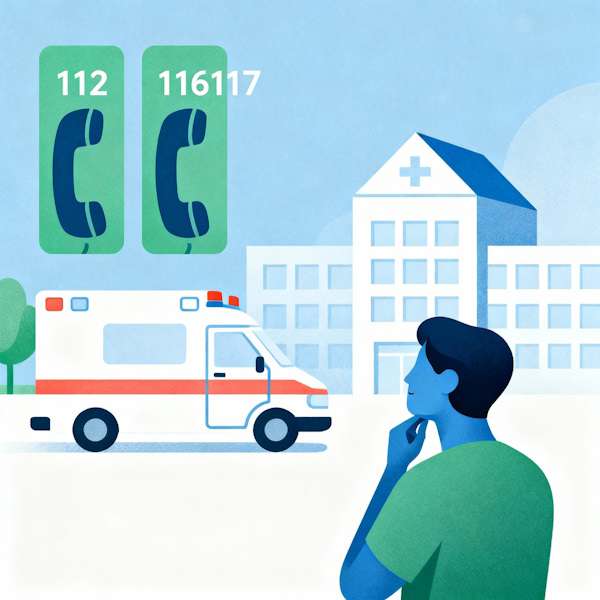
If you get sick in Germany, the “correct” behavior is important. You should inform your employer quickly (many workplaces require a phone call early in the morning). If you need a doctor’s note (Arbeitsunfähigkeitsbescheinigung), your employer will tell you when it is required.
Legally, continued payment of wages during illness is a core protection: if you are unable to work due to illness, you can have a right to continued pay by the employer for up to six weeks, under specific conditions.[6] After that, many people receive sick pay via health insurance, but the exact situation depends on your insurance and employment status.
Practical tip: If you are unsure where to go when you are sick (family doctor, urgent care, emergency services), read a clear overview first so you choose the right option and avoid unnecessary stress.
Pay Basics: Minimum Wage, Payslips, and Why “Gross” Matters
Germany has a statutory minimum wage that changes over time. According to the Federal Ministry of Labour and Social Affairs, the minimum wage is 12.82 EUR gross per hour since January 1, 2025, and it is scheduled to rise to 13.90 EUR on January 1, 2026, and to 14.60 EUR on January 1, 2027.[2] Many exceptions are limited, so most employees should receive at least this minimum.[2]
Your salary is usually shown as:
- Gross pay: the amount before taxes and social insurance contributions.
- Net pay: the money that arrives in your bank account after deductions.
This difference is often surprising for newcomers. If you are comparing job offers, always ask whether the employer is talking about gross or net. In Germany, salaries are normally discussed as gross.
Your payslip (Lohnabrechnung) is also useful proof for many situations, for example housing applications or residence permit processes. Keep your payslips and your contract together in a folder (digital or paper).
If Something Feels Wrong: Where to Get Help in Lower Saxony
Some problems can be solved by a calm conversation with your supervisor or HR. But if you suspect serious issues, like unpaid wages, illegal deductions, or pressure to sign something you do not understand, you should look for support early. Two practical resources are:
- Job and career support from your local employment agency. For example, you can find services and contact options via the Agentur für Arbeit Oldenburg-Wilhelmshaven page.
- Free labour and social law advice for migrants and refugees through the Faire Integration network, including topics like wages, working hours, vacation, termination, and social insurance.
Another important path is unions. Many sectors in Germany are organized through unions, and membership can provide advice and legal support (often after a waiting period). If your workplace has a Betriebsrat (works council), they can also be a helpful contact for workplace issues.
A Practical Mini-Checklist: From Offer to First Month
If you want a simple plan, use this checklist. It reduces mistakes and helps you feel in control:
- Read the contract slowly: check pay, hours, location, probation, end date (if fixed-term), and notice period.[1][7]
- Confirm working time and breaks: especially if shifts or overtime are common in the sector.[3][4]
- Check vacation rules: how many days, and when you can use them.[5]
- Prepare your documents: ID, residence permit, bank account, tax info if requested, health insurance details.
- Track your hours for the first months: keep your own notes (start time, end time, breaks) in case of later disagreements.[3][4]
- Keep every payslip and every important email in one folder.
- If you get sick: inform your employer quickly and follow the rules for medical certificates.[6]
If you are combining work with study, a training program, or a job search plan, it helps to learn the system step by step and avoid random decisions. For example, many newcomers start with an entry job, then move to an Ausbildung once their German improves.
You can also explore structured pathways by reading this practical guide to finding an Ausbildung position in Lower Saxony, and if you already have a degree from abroad, it is often smart to plan recognition early so you do not get stuck in the wrong level of work.
References
- [1] Make it in Germany, “Work contract”: https://www.make-it-in-germany.com/en/working-in-germany/working-environment/work-contract
- [2] Federal Ministry of Labour and Social Affairs (BMAS), “Einführung und Anpassungen des Mindestlohns”: https://www.bmas.de/DE/Arbeit/Arbeitsrecht/Mindestlohn/Einfuehrung-und-Anpassungen-Mindestlohn/einfuehrung-und-anpassung-mindestlohn.html
- [3] Gesetze im Internet, Arbeitszeitgesetz (ArbZG) § 3: https://www.gesetze-im-internet.de/arbzg/__3.html
- [4] Gesetze im Internet, Arbeitszeitgesetz (ArbZG) § 4: https://www.gesetze-im-internet.de/arbzg/__4.html
- [5] Gesetze im Internet, Bundesurlaubsgesetz (BUrlG) §§ 3-5: https://www.gesetze-im-internet.de/burlg/
- [6] Gesetze im Internet, Entgeltfortzahlungsgesetz (EntgFG) § 3: https://www.gesetze-im-internet.de/entgfg/__3.html
- [7] Gesetze im Internet, Bürgerliches Gesetzbuch (BGB) § 622: https://www.gesetze-im-internet.de/bgb/__622.html